

It’s incredibly hard to narrow down the best fit when searching for a financial advisor. In Michigan alone, there are nearly 7,860 personal financial advisors(per BLS data). They may go by Wealth Advisor, Financial Planner, Insurance Salesperson, Money Manager, Investment Manager… The list can go on. On top of that, there’s the “best” licensing… CFA, CFP, CPA, CHFC, CRPC, CAIA, AIF… This list can go on even longer.
However, the most important thing to focus on isn’t the title on their business card; it’s the structure of their firm and how they treat you.
The Solo-RIA (Registered Investment Advisor) Advantage
That’s why understanding the type of firm you are dealing with is crucial. In particular, working with my RIA Firm offers distinct advantages:
Direct Access: You reach the exact person who built your plan, not a junior associate or a call center.
Fiduciary Duty: Fee-only RIAs are legally required to act in your best interest, a welcome change from commission-driven advice.
Personalized Service: While the industry median is 235 households per advisor, I cap my list at 100 to ensure high-quality, relationship-driven service.
Long-Term Continuity: You won’t face frustrating handoffs or reassignments. One advisor knows your full history.
Unbiased Independence: As an independent CFA charterholder, I provide fee-based advice that no parent company steers toward its in-house funds.
Speed & Agility: A solo advisor can quickly adapt strategies and technology without waiting on corporate committee decisions.
The Importance of Being Heard
That said, none of the perks matter if you aren’t heard. Just because an advisor is at a big firm, it doesn’t mean they are going to be dismissive. And just because an advisor is independent, it doesn’t mean they are going to be a great fit. Regardless of the type of firm, a great advisor should do more asking than selling, and they shouldn’t be afraid to challenge your assumptions. For example, if you walk into a meeting demanding specific policies and they blindly agree, be wary. After all, their job is to teach you about your options and dig into your reasoning.
Total Transparency in Fees
Fees are another blind spot. Advisors often highlight their management fee while glossing over fund expense ratios or commissions. By contrast, because an independent RIA controls their own overhead, they can avoid the bloat of traditional wirehouses. That savings only shows up if the advisor keeps their AUM (Assets Under Management) fee reasonable, though.
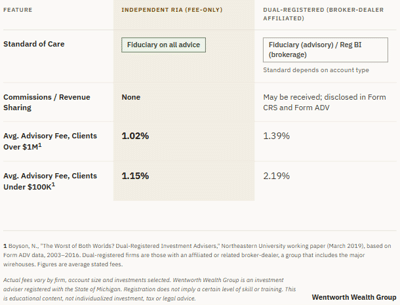
For my part, I operate strictly on a fee-only basis, meaning I do not receive commissions. As a result, I have the flexibility to select the best-fitting, most favorably priced funds for you without a corporate ‘Approved Buy List’ limiting my choices.
Before you commit to anyone, here are a few questions to ask a prospective advisor:
- “What would make you tell me not to do something I came in wanting?”
- “Am I working with you directly, or could I get reassigned to someone else on your team?”
- “What is my all-in cost as a percentage of assets, combining your fee and the underlying fund costs?”
Ultimately, my approach is rooted in explaining the “Why.” I take the time to understand your investment knowledge, risk tolerance, and goals. As a client, you will hear from me at least quarterly and always have access to meetings upon request.
Whether you’re just starting out or reassessing, get an advisor to help you organize your wealth and simplify your financial life.
Contact me, check out my newsletter, or visit my website. I offer meetings or a free net worth analysis if you want a clearer picture of your finances. There will be no obligation, no product pitch, just a conversation about where things stand.
Thanks for taking the time to read. I look forward to connecting with you.
Sources
● U.S. Bureau of Labor Statistics, Occupational Employment and Wage Statistics, May 2023 — Personal Financial Advisors (SOC 13-2052), Michigan (bls.gov/oes/2023/may/oes132052.htm).
● Dimensional, “Firms Wrestling with Capacity Constraints, and Other Insights from 2025 Global Advisor Study” (dimensional.com/us-en/insights/firms-wrestling-with-capacity-constraints-and-other-insights-from-2025-global-advisor-study).
● Boyson, Nicole M. “The Worst of Both Worlds? Dual-Registered Investment Advisers.” Northeastern University, D’Amore-McKim School of Business, working paper, March 2019. Based on Form ADV data, 2003–2016. https://www.villanova.edu/content/dam/villanova/VSB/undergrad/Boyson-The-worst-of-both-worlds-Dual-registered-investment-advisers.pdf
Helpful Hints
Resources

When Do You Need a Financial Advisor? A Few Life Changes That Signal It’s Time

What Does a Wealth Advisor Do? Go Beyond Picking Investments
Ready to see your full picture?
